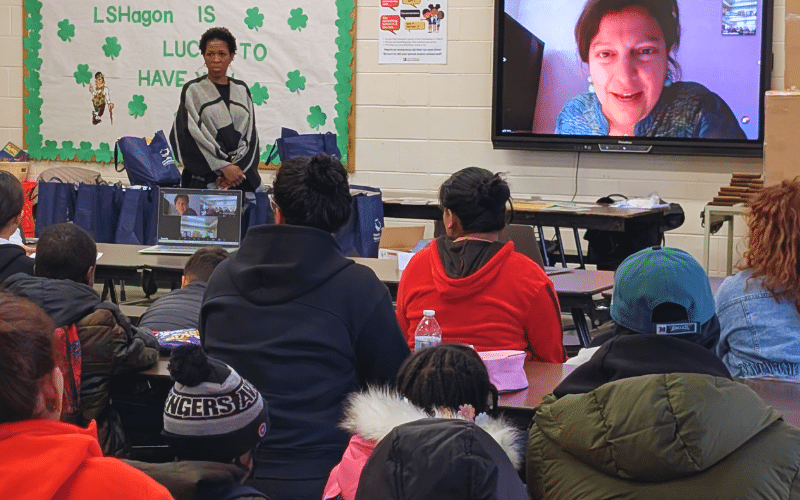
By Healthy Courier staff, Catholic Partnership Schools, St. Joseph-Pro Cathedral | Half a world away from New Jersey, students in Nepal learned about the types of snacks their American peers enjoy. Likewise, students at St. Joseph Pro-Cathedral School in Camden were excited to try some Nepalese foods.
What they didn’t expect—in this age of instant communication—was having so much difficulty making a connection! Their best laid plans got interrupted by weather, technical difficulties, distance, and resources. But they persevered and talked about what they learned.
“I learned that people from different countries have different ways of making food. The Nepal people make food based on their environment,” said Jace Schwartz, a St. Joseph Pro-Cathedral reporter.
The Nepalese students attend Kopila Valley School in a valley in the Surkhet Province, according to their teacher, Anjali Karki. Nepal is located in south Asia between India to the east, south, and west, and Tibet to the north. It’s approximately 7,600 miles from Philadelphia and a flight there takes 21 to 25 hours!
The plan was for a group of reporters at Kopila Valley to sample some American snack foods and a group of Healthy Courier reporters at St. Joseph to taste foods from Nepal. Each group would film their reactions to tasting the new foods, connect with each other, and learn about their different lives. The St. Joseph reporters tried a variety of Nepalese food. As of publication, the students in Nepal have not had the chance to test the U.S. food.
“As Americans, we get our food from stores, but since the Nepal people live in the mountains, they don’t have the same kinds of stores or markets like we do, so they grow their food and cook it themselves,” said Jace. “The Nepal people learn the ability to cook and not order take-out food. They cook for each other and themselves. They connect to each other through cooking and eating food together.”
Kopila student Dimple said she enjoys making family meals. The special dishes include daal (lentils), bhatt (cooked rice), and takari (mixed vegetables).
Also popular, Dimple said, is atchara, a pickled condiment. “We love to eat it as much as we love it make it,” she said.
Learning doesn’t always come from textbooks
Teacher Karki said “making real-world connections for our students is at the heart of meaningful learning. Education is not just about textbooks—it’s about helping students understand the world they live in and their place within it.”
Rowan University anthropology professor Dustin Cushman told St. Joseph reporters that food is more than nourishment. “It also connects us to people around the world and helps us learn about different cultures,” he said. “It strengthens bonds and helps people to socialize through food.”
Professor Cushman noted that in many cultures, elders teach younger family members to cook. “Through these connections, food can be passed down to multiple generations,” he said. “Cultures that have gone through changes push the idea on how dishes are prepared and eaten. Even when people move from one country to another, the food from their homeland keeps them connected to their culture.”
Even though the Nepalese didn’t get to try American snacks, teacher Karki hopes the connection with American students will “provide them with insights, help them see different lives in different parts of the world and make them curious. “Most of our students come from places where they don’t have any means of knowing the rest of the world,” she said.
For their part, the St. Joseph reporters learned that Nepal has “a very diverse culture consisting of food, culture, and religion. They use lots of flavorful seasoning in their food, and they have a very rich culture” with different ethnic and religious groups, said Kylar Harris.
“We could tell from tasting their food that people in Nepal use many different types of spices,” said Matthew Nieto. “Nepal also makes wonderful food such as momo, which is a very flavorful meal with many spices. When you take a bite of momo, a burst of spices and flavors will unfold and that’s what makes it delicious,” he said.

In addition to momo (dumplings filled with chicken), St. Joseph students also sampled roti (a bread-like food that wrapped vegetables with spices inside), and lassi (a yogurt-based drink.) The food got good reviews.
“The food was a new experience; it had a hint of sweet and spicy. I liked the combination of both tastes, and the sauces that came along with the food were also very good. I’m sure to come back to Nepalese food, it’s truly delicious!” said William Hernandez said. He also said St. Joseph students “were intrigued” when they learned Nepalese students can cook their own food. “It’s an essential life skill,” he said.
Another Nepalese student is a member of the school’s cooking club and enjoys making food for the school, saying: “I feel very happy and excited when I cook food for myself. I can choose healthy food and try out new recipes. It also helps me to learn basic skills like cooking, planning, and being a responsible person.”
The food that unites cultures
One food that both American and Nepalese students have in common is pizza!
Dimple said pizza connects her with her family. “We make pizza once a week, every Friday,” she said. “To make pizza, first we collect all required material on Wednesday and on Thursday we make dough for pizza and keep it in the freezer and cut vegetables like olives, onion, and tomatoes.”
Despite their many differences, St. Joseph and Kopila Valley students have one thing in common: They’re both learning to be reporters. “They learn about reporting and newswriting in their course, which through this collaboration (with St. Joseph) they can put in action” said teacher Karki.
Learn more about our From Camden to Nepal project.
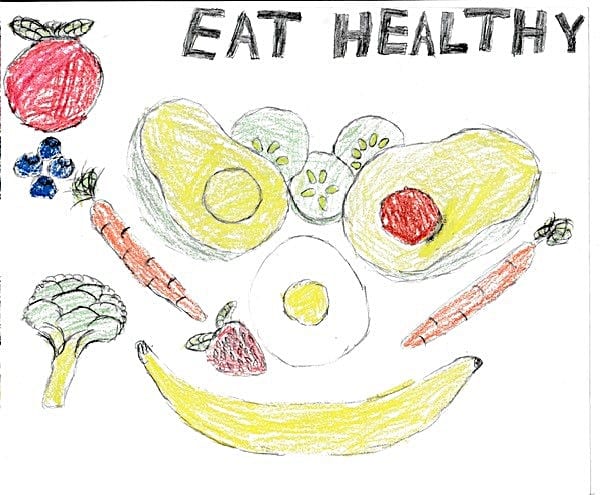
Illustration by Rodrigo, 5th grade, Yorkship, 2025-26.