By DePaul Healthy Trailblazer Journal reporters | In April 1968, when Keith Prewitt was 14, he and his friends were “out and about” in a part of downtown Memphis, Tenn., where they weren’t supposed to be. They started to get nervous when they saw a lot of fire trucks and police cars coming to the area.
“We didn’t know what was going on, but we chose to get out,” Mr. Prewitt says. “Before we made it home, we were stopped by a police officer. The individual who got out of the police car had to be the biggest human being I’d ever seen in my life.” He was about 6-feet-6-inches tall and had a crew cut like a U.S. Marine.
Mr. Prewitt and his friends were expecting the police officer to call them very bad names and send them to jail. Instead, the officer said, “‘Young men, where are you going?’”
Mr. Prewitt says he and his friends were surprised. They looked at each other and said, “‘Young men?’ Who is this guy talking to?”
The officer asked them whether they knew that the city had a curfew. The boys replied “no.”
The officer asked another question: “‘Do y’all know that Dr. King was just assassinated?’ And our jaws dropped, and we said, ‘Sir, we didn’t know.’”
The police officer then said he had seen them in their neighborhood. He knew Mr. Prewitt was a good football player and his friends were on the high school baseball and basketball teams.
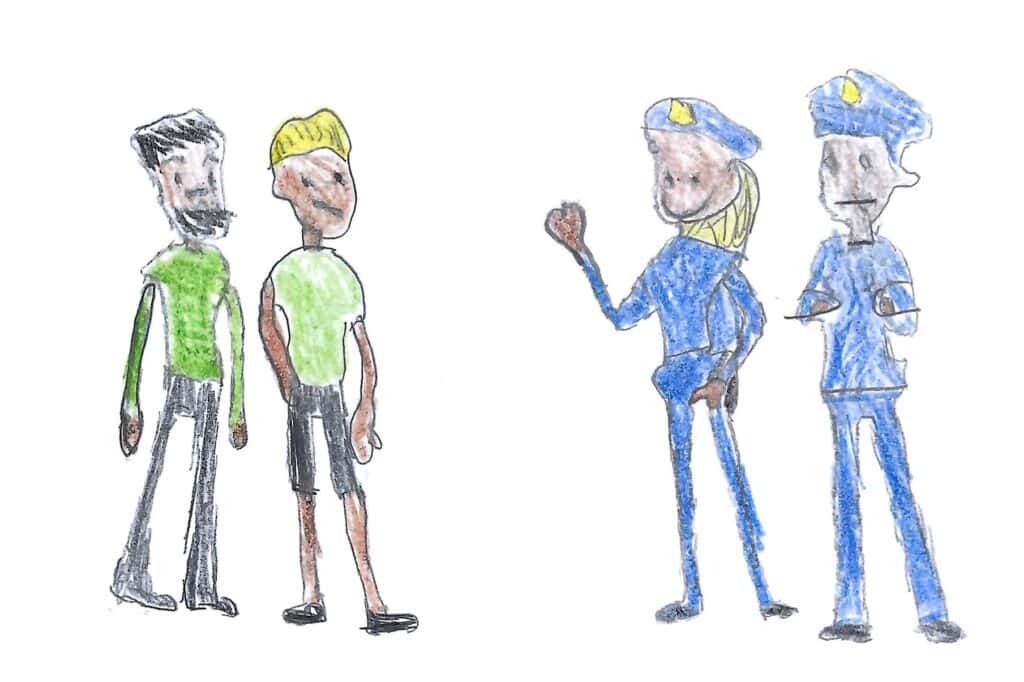
Illustration by Devin, eighth grade
Mr. Prewitt and his friends were amazed that the officer knew an interesting fact about each one of them. The officer told them that he knew they were very good kids.
But that day in Memphis, the officer still had a job to do. He gave the boys a choice: He could take them to juvenile court, or they could tell their parents
that they had been stopped by a police officer after curfew. They chose to tell their parents themselves.
Fast-forward about 10 years: After playing football for Memphis State University (now The University of Memphis), Mr. Prewitt was recruited by the city’s police department. At the police academy graduation ceremony, the same officer who had stopped his friends and him pinned his badge to his uniform.
Mr. Prewitt went on to a career in public safety and security, including service as a deputy director of the U.S. Secret Service. He and the Memphis officer remained good friends until the officer passed away years after their first meeting.
“He helped shape my decision to go into public service,” Mr. Prewitt says. “And I am forever indebted to him for that .”
Read more on page 8 in our Fall magazine.